




You’ve seen it on every shirt spec sheet: “100% ring-spun cotton,” “Airlume combed,” “100% cotton (open-end).” Most print shop customers don’t actually know what any of that means, but they can feel the difference the second they touch the shirt. Here’s the science in 60 seconds, then the practical impact on your quotes.
How cotton yarn gets made
Cotton comes off the plant as short fibers tangled in seed pods. To turn it into thread that can be woven into fabric, the fibers have to be combed, aligned, and twisted together. That twisting process is what determines whether the thread is “ring-spun” or “open-end.”
Open-end spinning (OE)
Fibers are fed into a rapidly rotating rotor that packs them together and twists them mechanically. It’s fast, cheap, and doesn’t require the fibers to be very aligned. The output is a thicker, more uneven thread with slightly sticky-up fiber ends. The fabric made from open-end yarn is coarser and has a rougher surface feel.
Typical fabric weights by yarn type
Heavier isn't better or worse — it's a different product: workwear body vs retail drape.
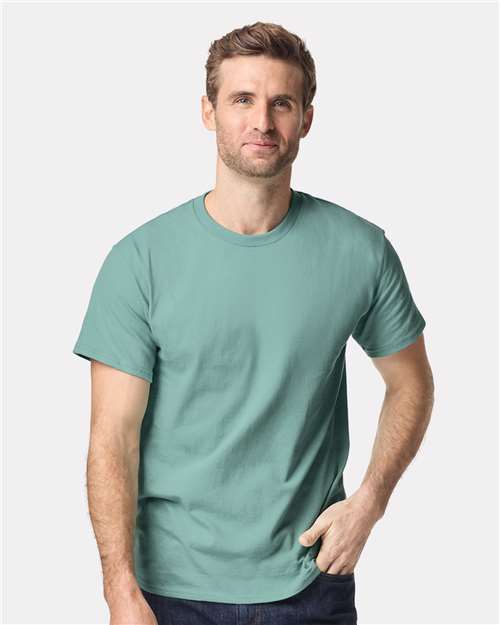
Classic example: Gildan 5000 Heavy Cotton. Price point: ~$2.30 wholesale for a basic color/size.
Ring spinning
Fibers are first combed to remove short and damaged strands, then drafted into a very fine ribbon, and finally twisted into yarn by a rotating ring traveler. It’s slower and more expensive, but the result is a stronger, smoother, more uniform thread. The fabric made from ring-spun yarn has a flatter surface and a noticeably softer hand.
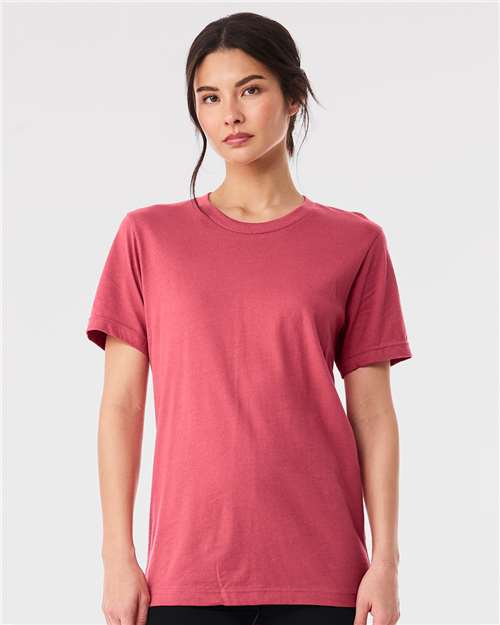
Classic examples: BELLA+CANVAS 3001, Next Level 3600, Gildan Softstyle 64000. Price point: $3.10–$4.80 wholesale.
Combed ring-spun (the premium tier)
If you comb the cotton twicebefore spinning it — removing almost all short fibers and impurities — you get “combed ring-spun” yarn, which is softer and stronger than regular ring-spun. BELLA+CANVAS markets their proprietary version as “Airlume.”
What customers feel: a smoother, almost jersey-like hand that doesn’t pill as easily and doesn’t feel “crispy” out of the package.
Why the difference matters to a print shop
- Print quality. Ink sits down flatter on ring-spun cotton. Halftones look sharper, fine lines hold their detail, and the print doesn’t pick up fiber fuzz during printing. Open-end prints can look grainy under a loupe.
- Customer perception. A buyer who touches a ring-spun shirt will describe it as “nice,” “premium,” or “retail quality.” A buyer who touches an open-end shirt will describe it as “fine,” “basic,” or “cheap.” Same buyer, different word, $4–$6 different price point.
- Durability. Ring-spun yarn is stronger per gram, so a 4.2 oz ring-spun tee often outlasts a 5.3 oz open-end tee in the washer. The industry myth that “heavier is better” dies the first time you wash a BELLA 3001 40 times.
How to talk about it on a quote
Most customers don’t want the fabric science lecture. They want to know which is worth the extra money. Put it in one line on your quote:
“We offer two blank tiers: a 5.3oz heavy cotton at $8/shirt (great for events and teams) and a 4.2oz Airlume ring-spun at $13/shirt (softer hand, retail-quality fit and feel). Let me know which you’d prefer and I’ll lock the quote.”
You just turned the pricing conversation into a tier choice. Most customers will pick the premium tier if you give them language to explain the upgrade.
The one-sentence summary
Ring-spun cotton is smoother, softer, more uniform, and prints better than open-end cotton — and customers can feel the difference even if they can’t name it. Stock both tiers, price accordingly, and let the customer self-select.
Where to buy both tiers wholesale
B2B Sportswear stocks every open-end and ring-spun blank you’d want — 200,000+ SKUs across 100+ brands — at true wholesale pricing from the first piece, with no minimums and no annual fee. Six quantity-break tiers apply automatically in the cart, and mixing sizes and colors within a style still counts toward the break. Orders in by 1 PM EST ship same day from the closest US warehouse, Ground shipping is free at $265+, and everything arrives plain-packed. Browse wholesale t-shirts, compare tiers on bulk pricing, or start with the Gildan Softstyle 64000 — the cheapest way into ring-spun.
FAQ
Is ring-spun cotton better than regular cotton?
Ring-spun cotton is smoother, softer, and stronger per gram than open-end (“regular”) cotton because the fibers are combed and aligned before twisting. It also prints sharper. Open-end still wins on price for event and giveaway shirts.
What does combed ring-spun cotton mean?
The cotton is combed to remove short and damaged fibers before ring spinning, producing an even smoother, stronger yarn. BELLA+CANVAS’s branded version of this process is called Airlume.
Why do ring-spun t-shirts cost more?
Ring spinning is slower and wastes more raw cotton than open-end rotor spinning. Expect around $3.10–$4.80 wholesale for a ring-spun tee versus around $2.30 for an open-end Gildan 5000 — and a $4–$6 higher retail price to match.
Does ring-spun cotton shrink more than open-end?
No — shrinkage is driven by knit tension and finishing, not the spinning method. Both typically shrink 3–5% on first wash unless pre-shrunk, so tell customers to expect it either way.