

Ask ten decorators the best t-shirt fabric for printing and you’ll get ten answers, because they’re all answering a different question. The honest answer depends on three things: what ink system you’re putting on it, what hand feel the end customer expects, and what the blank costs. This guide walks the three fabric families — 100% cotton, 50/50 cotton-poly, and triblend — through all three questions.
What’s actually in the fabric
- 100% cotton — comes in two very different grades. Open-end cotton (the 5.3 oz Gildan 5000) is coarser and cheaper. Ring-spun combed cotton (BELLA+CANVAS 3001, Gildan Softstyle) has longer, smoother fibers — softer hand, flatter print surface.
- 50/50 blend — half cotton, half polyester. The workhorse is the 5.5 oz Gildan 8000 DryBlend. Polyester adds wrinkle resistance, moisture wicking, and shrink control; cotton keeps it breathable and printable.
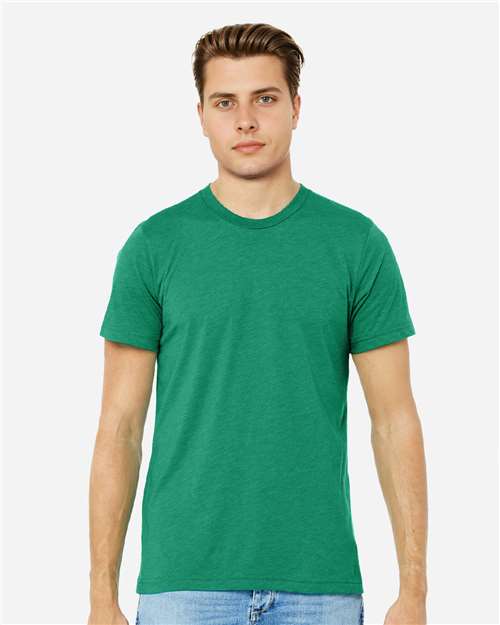
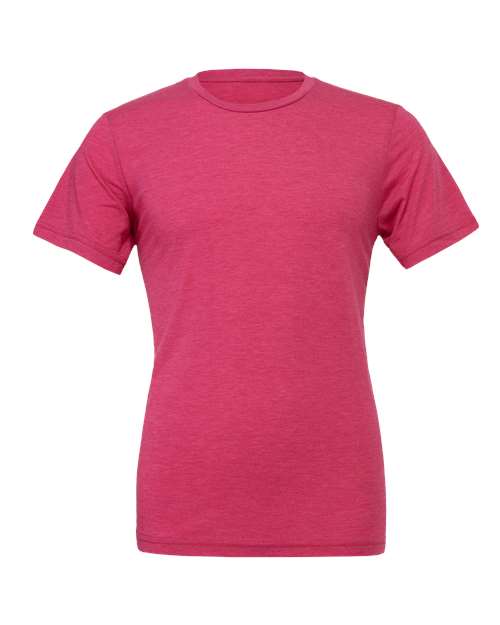
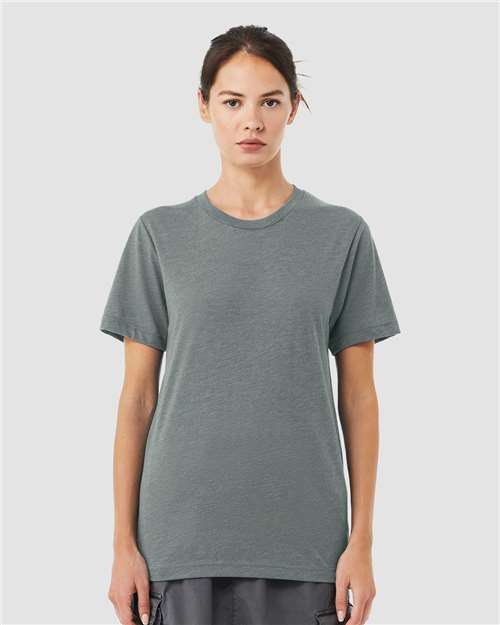
- Triblend — typically 50% polyester / 25% cotton / 37.5–25% rayon depending on the mill. The benchmark is the 3.8 oz BELLA+CANVAS 3413. Rayon gives it the drape and the signature heathered, almost slubby texture. Lightest and softest of the three.
How each fabric prints, by method
Plastisol screen printing
Plastisol sits on top of the fabric rather than soaking in, so it prints acceptably on all three. The real hazard is dye migration: polyester dyes re-activate around 280°F and bleed up into the ink, turning a white print on a red 50/50 shirt pink over a few days. On blends and triblends, use a low-bleed or poly-white underbase and cure low. On 100% cotton, print anything, cure at standard temps, and sleep fine.
Water-based and discharge
Water-based inks dye the cotton fiber itself, so the more cotton, the better the result. On ring-spun 100% cotton, discharge printing produces that no-hand vintage print customers love. On a 50/50, only the cotton half takes the ink — prints come out intentionally faded, which can look great or muddy depending on the art. On triblends, discharge is unpredictable because rayon and polyester don’t discharge; most shops switch to a soft plastisol or HSA water-based system instead.
DTG (direct-to-garment)
DTG pretreat and water-based pigment inks are formulated for cotton. 100% ring-spun combed cotton is the gold standard. 50/50s print at maybe 80% of the vibrancy. Triblends can DTG surprisingly well for a light, vintage aesthetic — but expect muted colors and test first.
DTF (direct-to-film)
DTF transfers glue a printed film to the surface, so fiber content barely matters — it’s the great equalizer and the safest choice for triblends and polyester-heavy garments. Trade-off: a heavier hand than any direct print, which fights the whole point of buying a buttery 3.8 oz triblend.
Side-by-side comparison
| Factor | 100% cotton | 50/50 blend | Triblend |
|---|---|---|---|
| Plastisol | Excellent, no bleed risk | Good — use low-bleed ink | Good — low cure temps |
| Waterbase/discharge | Excellent | Faded/vintage result | Unpredictable |
| DTG | Excellent | Acceptable | Muted, vintage only |
| DTF | Excellent | Excellent | Excellent |
| Shrinkage | 3–5% (worst) | 1–3% | Minimal |
| Wholesale cost | Around $2–$5 | Around $2.50–$4 | Around $5–$7 |
What's actually in a tri-blend
That 50% poly share is also why tri-blends give prints a heathered, vintage fade.
Shrinkage: the complaint you can prevent
Open-end 100% cotton is the shrink champion — a tubular-knit cotton tee can lose 3–5% in length after a hot wash and dry, enough that a customer notices. Ring-spun styles are usually pre-shrunk and behave better, but still move more than blends. Polyester and rayon barely shrink, which is why a 50/50 like the Gildan 8000 holds its printed dimensions and why uniform programs love it. If a customer plans to retail the shirts, put expected shrinkage in the quote — it’s a one-line disclaimer that prevents a reprint argument.
The price ladder, and how to sell it
Think of the three fabrics as quote tiers. Open-end cotton around $2–$3 wholesale is your budget tier for events and giveaways. The 50/50 sits just above it and wins any job involving sweat — teams, work crews, restaurant staff. The triblend at around $5–$7 is your premium tier: it retails at $25–$30+ printed, so even at double the blank cost your percentage margin often improves. Quote two tiers on every job and let the customer upsell themselves.
We built B2B Sportswear for exactly this kind of tiered buying: 200,000+ SKUs across 100+ brands, true wholesale pricing from the first piece, and six quantity-break tiers applied automatically in the cart. You can mix sizes and colors within a style and still hit the break, so ordering 24 triblends and 48 cotton tees for the same job doesn’t punish you. Orders over $265 ship free via Ground, same-day by 1 PM EST from our closest US warehouse.
Where to buy
Start with the three benchmarks: Gildan 5000 (100% cotton), Gildan 8000 (50/50), and BELLA+CANVAS 3413 (triblend) — or browse the full t-shirt catalog. No minimums, no annual fee, plain unbranded packaging, and tax-exempt checkout with a resale certificate. See bulk pricing for the full quantity-break schedule.
FAQ
Is triblend or cotton better for printing?
For print quality alone, ring-spun 100% cotton wins — it takes plastisol, waterbase, and DTG better than any blend. Triblend wins on hand feel and drape, and prints well with soft plastisol or DTF. If the job is retail merch where softness sells, triblend; if the art needs maximum vibrancy, cotton.
Can you print plastisol on a 50/50 shirt?
Yes, and shops do it every day. The one risk is dye migration: polyester dye can bleed into the ink at high cure temperatures, especially on red and other deep colors. Use a low-bleed white or a blocker underbase and keep cure temps at the low end of spec.
Do 100% cotton shirts shrink more than blends?
Yes. Expect 3–5% shrinkage from open-end tubular cotton after a hot wash and dry, and less from pre-shrunk ring-spun styles. Blends shrink 1–3% and triblends barely move, because polyester and rayon are dimensionally stable fibers.
What is the best t-shirt fabric for DTG printing?
100% ring-spun combed cotton, full stop — DTG inks are engineered to bond with cotton fiber. The BELLA+CANVAS 3001 and similar ring-spun tees are the industry standard DTG blanks. Blends print with reduced vibrancy, and triblends only suit a deliberately faded look.