



Ask a shop owner what went wrong in year one and you’ll hear the same list, in roughly the same order. None of it is exotic — it’s cure temperatures, quoting habits, and blank choices. Here are the ten mistakes that actually cost money, ranked by how often they show up, each with the fix.
1. Undercuring ink (the #1 cause of cracking)
Cracked or fading prints after the first wash are almost never an ink-brand problem — they’re a cure problem. Plastisol must hit its full cure temperature through the entire ink film, not just at the surface. The dryer’s display lies; the belt speed you used last winter is wrong in July.
The 5-minute margin-leak audit
- 1
Probe the ink film, not the dryer display
Undercure is the #1 cause of cracking
- 2
Wash-test one shirt from every large run
Before the customer does it for you
- 3
Log spoilage for one month
Most shops find 2–4% they never priced in
- 4
Re-quote your smallest run size
Small orders should carry your highest per-shirt price
- 5
Consolidate blank suppliers
One order, one freight bill, one quantity break
Fix: verify with a donut probe or temp strips on the ink film itself, re-check whenever ambient temperature changes, and wash-test one shirt from every large run before delivery.
2. Small orders priced like big ones
Setup — screens, registration, ink mixing — costs the same for 12 shirts as for 200. Shops that spread setup across imaginary volume lose money on every small run they “win.”
Fix: small orders carry your highest per-shirt price, not your lowest. Under ~24 pieces, quote DTF or vinyl instead. Full quoting method in our pricing guide.
3. Not charging for everything that costs you
Screen prep, art time, ink waste, test prints, and spoilage all have dollar values. If they aren’t in the quote, they’re in your margin.
Fix: build a quote template with line items for setup, art, and per-location printing — and a 2–3% spoilage allowance baked into the blank cost.
4. Buying blanks retail (or from too many vendors)
Paying retail for a blank that wholesales at about $3 doesn’t feel like a mistake on one shirt; across a year it’s a full margin’s worth of leakage. So is paying two freight bills because tees and bags come from different vendors.
Fix: one wholesale account with quantity-break pricing and no minimums, and consolidate orders. (That’s the entire pitch of B2B Sportswear: true wholesale from piece one, nationwide warehouses, same-day shipping by 1 PM EST.)
5. The wrong blank for the artwork
Fine halftones die on fuzzy open-end cotton; heavy plastisol cracks on stretchy tri-blends; white ink turns pink on red polyester (dye migration).
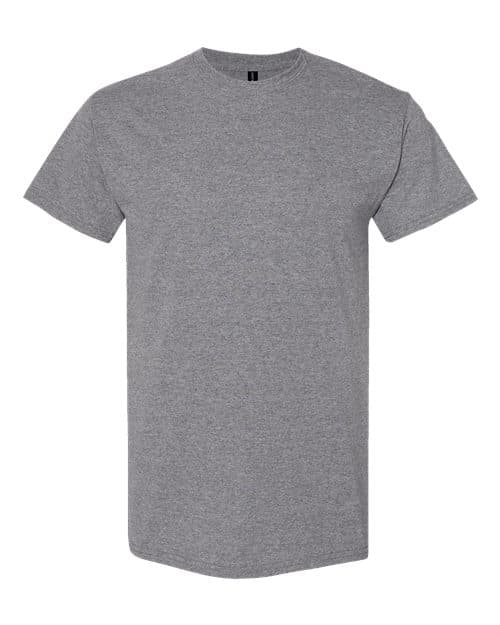
Fix: match blank to art. Bold spot colors → Gildan 5000. Fine detail and halftones → smooth ring-spun like the Softstyle 64000 or BELLA+CANVAS 3001 (see ring-spun vs open-end). Performance poly → low-cure ink and blockers.

6. Skipping the pre-press and test print
The first shirt off the press tells you about registration, off-contact, and pressure — printing it on a customer’s garment means discovering problems on inventory you must replace.
Fix: keep a stack of misprints and cheap test squares at the press; approve print #1 on scrap before touching the run.
7. Ignoring fibrillation on soft tees
On soft ring-spun tees, tiny fibers push through the ink film after a wash and make prints look faded — customers call it “cheap ink.”
Fix: print a thicker deposit through a lower mesh, use a matte-down second stroke, or add a clear top coat on premium soft-tee jobs.
8. No spoilage tracking
Every shop ruins shirts. Shops that don’t count them quote as if they don’t exist — and eat the difference on every job.
Fix: track misprints per job for one month. Most shops find 2–4%; price it in and order extras accordingly. Our inventory management guide covers buffer math.
9. Underestimating art and setup time
“Quick vector cleanup” is a lie the calendar tells. Art time is real labor, and unpriced revisions are unpaid work.
Fix: include one revision round in the quote; charge an hourly rate after that. Customers respect boundaries that are on the invoice.
10. Selling prints instead of programs
One-off jobs restart the sales cycle every week. The profitable accounts are recurring: schools, restaurants and breweries, gyms, and local businesses with uniform needs.
Fix: after every good one-off job, pitch the calendar: “want us to handle this quarterly?”
The pattern
Nine of these ten mistakes are process, not talent — and every one is cheaper to fix than to keep paying for. Start with #1 (buy the donut probe) and #2 (raise small-order pricing) this week; they’re the two that bleed the most. For the fundamentals end-to-end, our Screen Printing 101 guide covers the full process.
FAQ
Why is my screen print cracking after washing?
Undercured ink, almost always. The ink film must reach full cure temperature all the way through — verify with a donut probe on the ink itself, and wash-test a shirt from each run.
How much should I charge for a 12-shirt screen print order?
More per shirt than any other quantity — setup costs are spread across only 12 pieces. Many shops quote small runs at 2× their 72-piece rate, or route them to DTF where setup is near zero.
What is a normal spoilage rate in screen printing?
2–4% for most shops. Order extras on every job and build the allowance into your blank cost so a misprint never means buying one replacement shirt at panic speed.
What is the most forgiving blank shirt for beginners?
The Gildan 5000: stable, tightly knit open-end cotton that doesn’t stretch off registration, tolerates hot flashes, and costs little enough that test prints don’t hurt.